
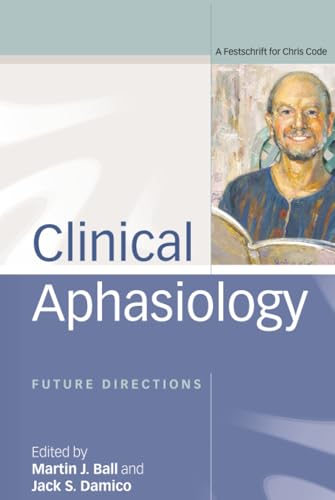
Clinical aphasiology : future directions / [edited by] Martin J. Ball and Jack S. Damico
Material type: TextPublication details: London : Routledge, 2014Description: 343 pISBN:
 - 1841696706
- 9781841696706
- 616.855 2 BAL D
| Cover image | Item type | Current library | Home library | Collection | Shelving location | Call number | Materials specified | Vol info | URL | Copy number | Status | Notes | Date due | Barcode | Item holds | Item hold queue priority | Course reserves | |
|---|---|---|---|---|---|---|---|---|---|---|---|---|---|---|---|---|---|---|
| Reference text books | All India Institute of Speech and Hearing | R-39/3 | 616.855 2 BAL D (Browse shelf(Opens below)) | Available | 15404 |
M. J. Ball, J. S. Damico, Preface. Chris Code's Contribution to Aphasiology. Part I: Conceptual Considerations. M. Herrmann, T. Fehr, Investigations in Speech and Language and Related Disorders: Crossing the Boundaries between Disciplines-a tribute to Chris Code. H. W. Buckingham, S. S. Christman, Independent Evidence for the Unification of Explanatory Paradigms in the Neurosciences. S. McDonald, The Social and Neuropsychological Underpinnings of Communication Disorders after Severe Traumatic Brain Injury. L. L. LaPointe, K. L. Lenius, Social Validation of Recovery in Aphasia. J.S. Damico, M. J. Ball, N. N. Simmons-Mackie, N. Muller, Interactional Aphasia: Principles and Practices Oriented to Social Intervention. Part II: Research Considerations. J.-L. Nespoulous, J. Virbel, From the Study of Language Dysfunction and Handicap to a Better Understanding of Linguistic Processing in Normality. I. Moen, Production and Perception of Word Tones in Patients with Brain Damage. B.E. Murdoch, Subcortical Aphasia: Historical Perspective and Contemporary Thinking. T. Bormann, G. Blanken, C.-W. Wallesch, Mechanisms of Lexical Selection and the Anomias. N. Muller, A. Kozlowski, P. Doody, Repetitive Verbal Behaviours in PML: An Exploratory Study of Conversation. A. Ferguson, Multiparty Interactions in Aphasia. E. Armstrong, H. K.Ulatowska, Stroke Stories: Conveying Emotive Experiences in Aphasia. Part III: Clinical Considerations. A.L. Holland, Counseling Families and Adults with Speech and Language Disorders: The View from a Wellness Perspective. C. Penn, Cultural Dimensions of Aphasia: Adding Diversity and Flexibility to the Equation. S. Edwards, R. Bastiaanse, Assessment of Aphasia in a Multi-lingual World. R.C. Katz, R.T. Wertz, Computerized Aphasia Treatment Outcomes Research: The Past and a Proposal. L. Togher, Traumatic Brain Injury Rehabilitation: Advanced Communication Training Perspectives. Y. Joanette, M. Champagne-Lavau, K. Kahlaoui, B. Ska, The Future of our Knowledge about Communication Impairments Following a Right-hemisphere Lesion. M. Pachalska, Progressive Language and Speech Disorders in Dementia. Author Index. Subject Index.
There are no comments on this title.