
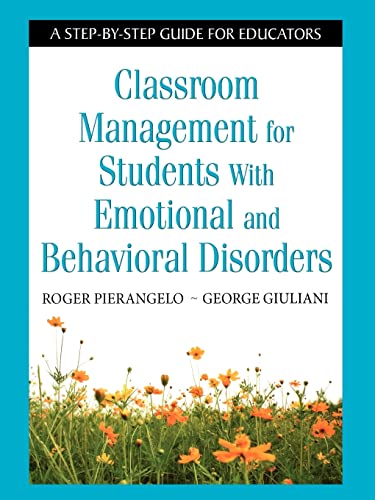
Classroom management for students with emotional and behavioral disorders : a step-by-step guide for educators / Roger Pierangelo, George Giuliani.
Material type: TextPublication details: Thousand Oaks, Calif. : Corwin Press, c2008.Description: xiii, 134 p.26 cmISBN:
 - 9781412917872 (pbk. : alk. paper)
- 371.94 ROG 22
- LC4181 .P54 2008
| Cover image | Item type | Current library | Home library | Collection | Shelving location | Call number | Materials specified | Vol info | URL | Copy number | Status | Notes | Date due | Barcode | Item holds | Item hold queue priority | Course reserves | |
|---|---|---|---|---|---|---|---|---|---|---|---|---|---|---|---|---|---|---|
| Stack text books | All India Institute of Speech and Hearing | 24/2 | 371.94 ROG (Browse shelf(Opens below)) | Available | 16231 |
Includes bibliographical references and index.
edications
About the Authors
Preface
1. Review Your Knowledge on Students With Emotional and Behavioral Disorders
Definition of Emotional Disturbance
Causes of Emotional and Behavioral Disorders
Prevalence of Emotional Disturbance
Age of Onset of Emotional and Behavioral Disorders
Gender Features of Emotional and Behavioral Disorders
Cultural Features of Emotional and Behavioral Disorders
Eligibility Criteria for Emotional Disturbance Under IDEA
Characteristics of Students With Emotional Disturbance
Children With Emotional Disturbances and School-Related Concerns
IDEA Exclusion of Students Who Are ?Socially Maladjusted?
2. Understand the Behaviors of Students With Emotional and Behavioral Disorders
Understanding Challenging Behaviors
Understand the Difference Between Symptoms and Problems
Behaviors That May Be Indicative of More Serious Problems
Symptomatic Behaviors Exhibited When a Child Has Low Levels of Tension
Symptomatic Behaviors Exhibited When a Child Has High Levels of Tension
Redirecting Students to More Appropriate Behaviors
Ways to Maintain Positive Changes in Student Behavior
Whole-Classroom Instructional Strategies
3. Become Culturally Competent When Working With Students With Emotional and/or Behavioral Disorders
4. Understand and Apply Principles of Reinforcement When Working With Students With Emotional and/or Behavioral Disorders
Principles of Reinforcement
What Is the Actual Reinforcer?
Factors Affecting Reinforcer Effectiveness
Checklist for Effective Reinforcement
Possible Reinforcers
Reinforcement of Appropriate Student Behavior
5. Promote Positive Social Interactions Among Students With Emotional and/or Behavioral Disorders
Why Are Social Skills Important?
Social-Cognitive Skill Development
The Role of Social Skills at School
Strategies to Foster a Sense of Belonging in the Classroom
Creating a Positive Classroom Climate
Teaching Social Skills Through Role Playing and Observation
The Classroom Teacher?s Power to Model Acceptance
Promoting Positive Social Interactions Among Students With and Without Disabilities
6. Apply Instructional Interventions for Specific Behaviors Exhibited in the Classroom by Students With Emotional and/or Behavioral Disorders
Instructional Interventions for Active Non-Compliance
Instructional Interventions for Attendance Problems
Instructional Interventions for Difficulty With Transitions
Instructional Interventions for Disrespect to Teachers
Instructional Interventions for Classroom Disruption
Instructional Interventions for Failure to Accept Responsibility for Own Behavior and/or Consequences for Misbehavior
Instructional Interventions for Interpersonal Relationships With Peers
Instructional Interventions for Out-of-Control Behaviors
Instructional Interventions for Passive Resistance
Instructional Interventions for Not Respecting Property or Personal Space of Others
Instructional Interventions for Verbal Aggression
Instructional Interventions for Verbal Outbursts
7. Understand and Implement Classroom Management Strategies for Students With Specific Psychological Disorders
Child and Adolescent Mental Health and Schools
Classroom Management for Students With Anxiety Disorders
Classroom Management for Students With Bipolar Disorder
Working With Students With Borderline Personality Disorder (BPD) in the Classroom
Working With Students With Depression in the Classroom
Working With Students With Obsessive Compulsive Disorder (OCD) in the Classroom
Working With Students With Oppositional Defiant Disorder (ODD) in the Classroom
Working With Students With Post-Traumatic Stress Disorder (PTSD) in the Classroom
Working With Students With Reactive Attachment Disorder (RAD) in the Classroom
Working With Students With Schizophrenia in the Classroom
References
Glossary
Index
There are no comments on this title.